


A Hanoi Tower Variation
2020-03-29
It is challenging to teach students recursion, especially in an introductory course where students are not yet familiar with complex data structures. Therefore, teaching concepts like searching on a tree might be premature. I realized why we often start with the Hanoi Tower problem when introducing recursive algorithms.
It’s an excellent problem for teaching because:
- It doesn’t involve complex data structures.
- The problem itself is an interesting game.
- It illustrates beautiful recursive ideas.
In the past, I have used this problem to introduce recursion. I tried to add a twist by assigning them a variation of the problem as an assignment.
The Variation
If all moves must be between adjacent pegs (i.e., given pegs A, B, C, one cannot move directly between pegs A and C, and vice versa), how should we write the recursive function?
Consider we want to move a tower of ’n’ from a peg named “from” to another peg “to” by using the peg “aux”, that is:
|
|
We need to ensure the condition:
|
|
Or equivalently:
|
|
If the auxiliary peg is not B, the task is straightforward. We proceed as in the classic Hanoi Tower solution:
|
|
Here, moveDisk() function moves disk #n from “from” to “to”.
If the auxiliary peg is B, the process becomes more complex, as demonstrated below:
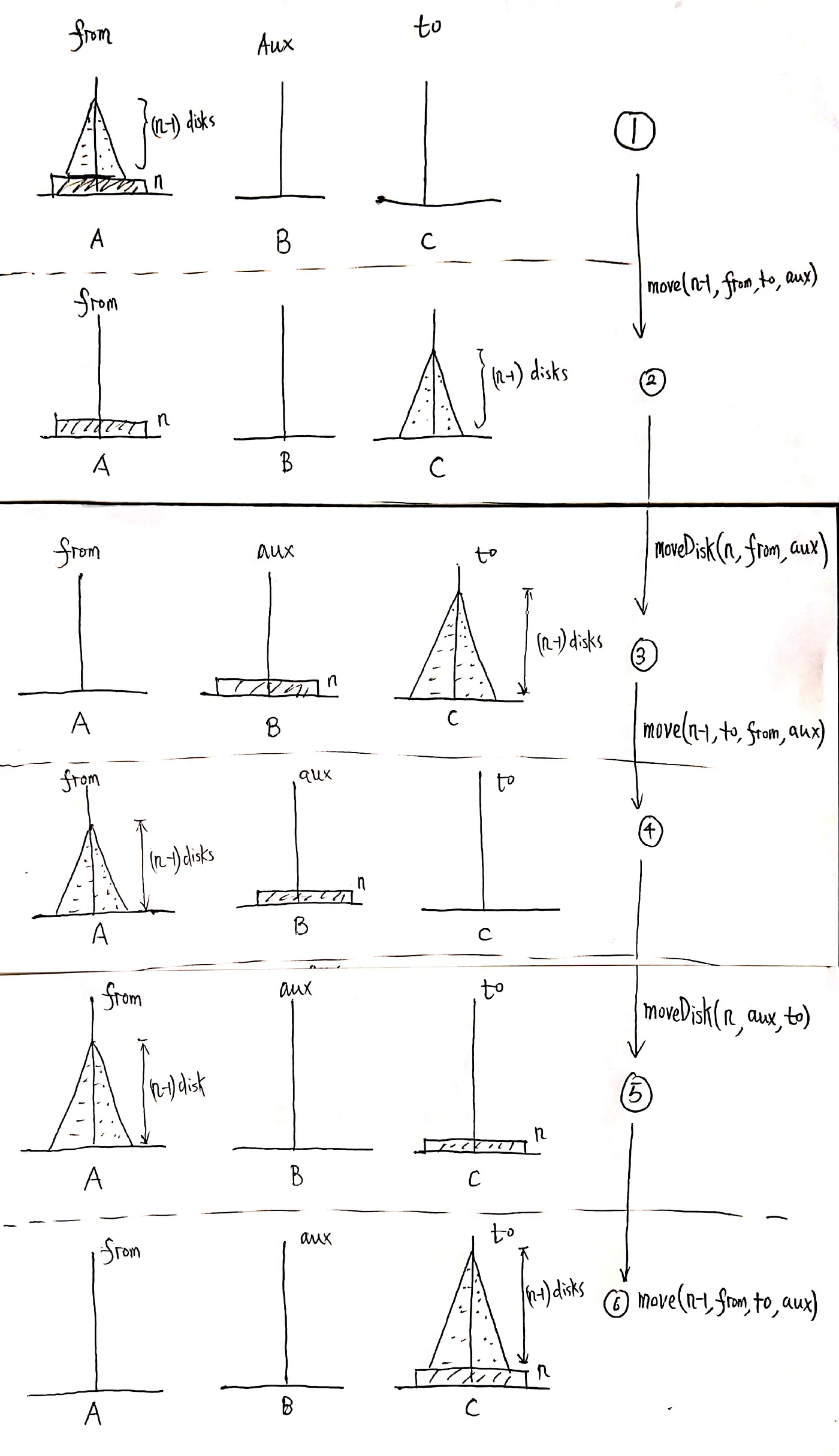
Question arises: How can we move from A to C directly? This is where our recursive function comes into play. We assume it is correct. It is not the moveDisk() function where we move one disk directly and are bound by the moving rule immediately.
Pseudo-code for the core function:
|
|
Java Implementation:
|
|
Algorithm Analysis:
How many steps does it take to move a tower of n from one place to another? Before we answer this, we must consider the starting and ending points, as there are obviously two different scenarios:
- The steps needed when the distance from source and destination is 1.
- The steps needed when the distance is 2.
Let:
- $f(n)$ be the number of steps needed to move a tower of n when the moving distance is 1.
- $g(n)$ be the number of steps needed to move a tower of n when the moving distance is 2.
Observing the pseudo-code of the core function, we have:
\[ f(n) = g(n-1) + f(n-1) + 1 \] \[ g(n) = 3g(n-1) + 2 \]
Detailed Solution for $ g(n) $:
We define a new function $ h(n) = g(n) + 1 $. The recurrence relation for $ g(n)$ becomes:
\[ h(n) - 1 = 3(h(n-1) - 1) + 2 \]
Simplifying this gives:
\[ h(n) = 3h(n-1) \]
Using the base case $ h(0) = g(0) + 1 = 1 $, we find:
\[ h(n) = 3^n \]
Substituting back for $ g(n) $:
\[ g(n) = h(n) - 1 \] \[ g(n) = 3^n - 1 \]
Detailed Solution for $ f(n) $:
Using the solution for $ g(n)$, we can solve $f(n)$:
\[ f(n) = (3^{n-1} - 1) + f(n-1) + 1 \]
Recognizing this as a geometric series, we can express it as:
\[ f(n) = \frac{3^n - 1}{2} \]
Output for $n=3$:
When $n=3$, the sequence of moves for the Hanoi Tower variation is as follows:
|
|
This sequence shows all the steps needed to move a tower of 3 disks from peg A to peg C using the variation of the rules where each move must be between adjacent pegs.